Emergent Gravity and the Collapse of the Wave Function

Updated: Jun 1, 2025
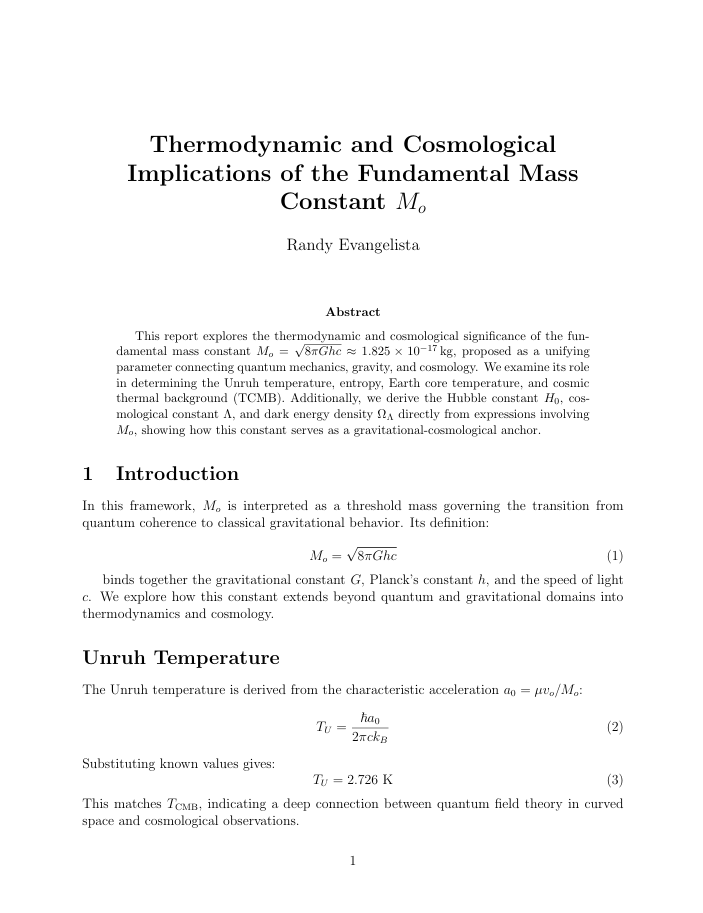
Gravity - an emergent property of the universe and does not exist in the quantum world. The properties of gravity can only be observed if the total mass reaches Mo.
Mo = 1.825E-17
Mo - a fundamental physical constant which can have different units of measure, (base units or derived units) depending on the equation being used. In contrast to constants with fixed units or unitless constants e.g. fine-structure constant, pi, etc.
Solving the equations for "Mo" will not give a single result, but multiple possibilities in the form of links.
Mo and the link to fundamental constants
Earth mass
Hydrogen mass
Reduced mass (hydrogen)
Proton mass
Electron mass
Neutron mass
Neutrino mass
Planck constant
Planck mass
Planck length
Planck time
Planck temperature
Gravitational constant
Boltzmann constant
Hubble constant
Cosmological constant
Rydberg constant
fine-structure constant
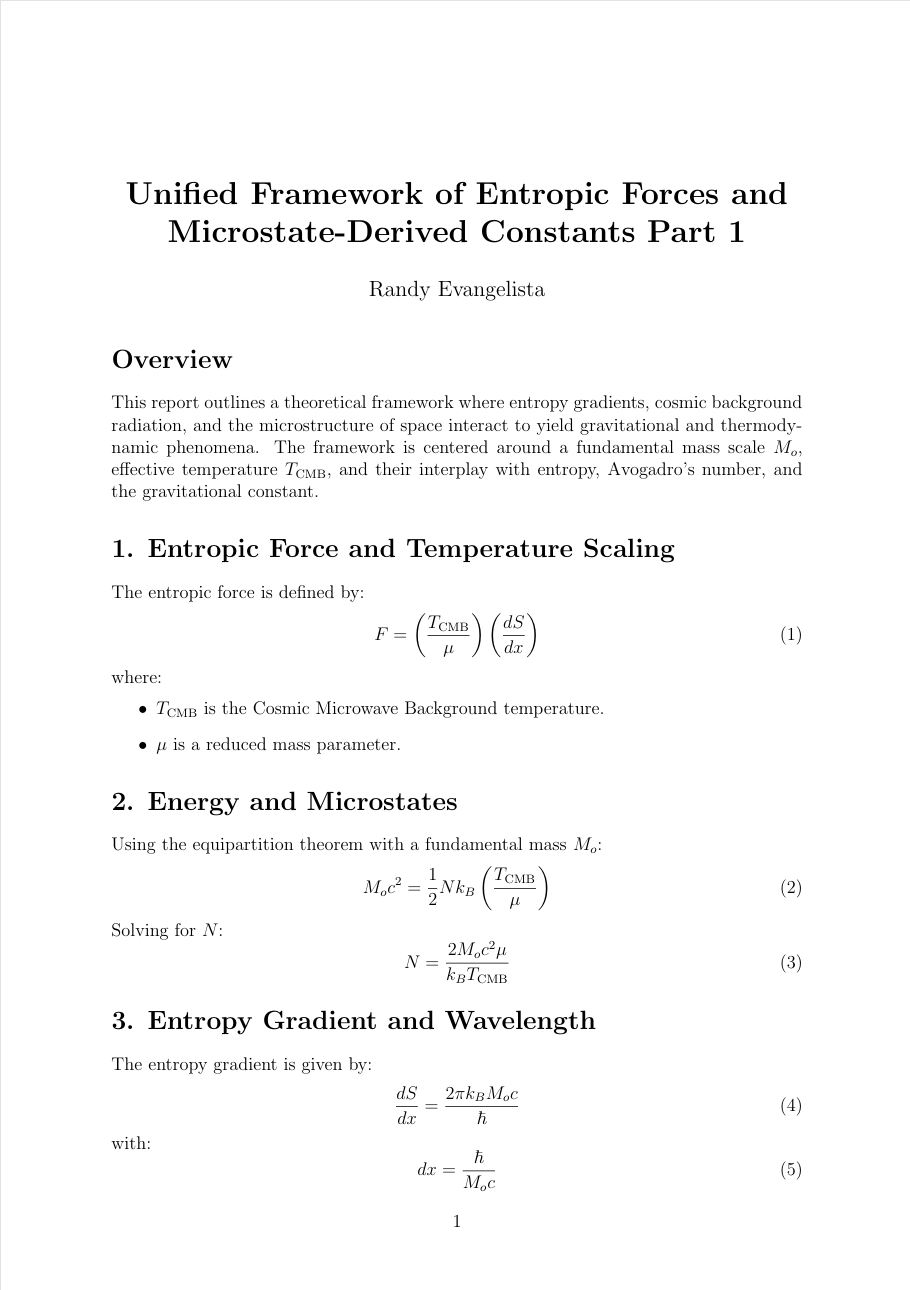
Entropic force
Casimir force
Number of microstates
Change in entropy
Vacuum density
Dark energy
Quantum representation of Kepler's third law
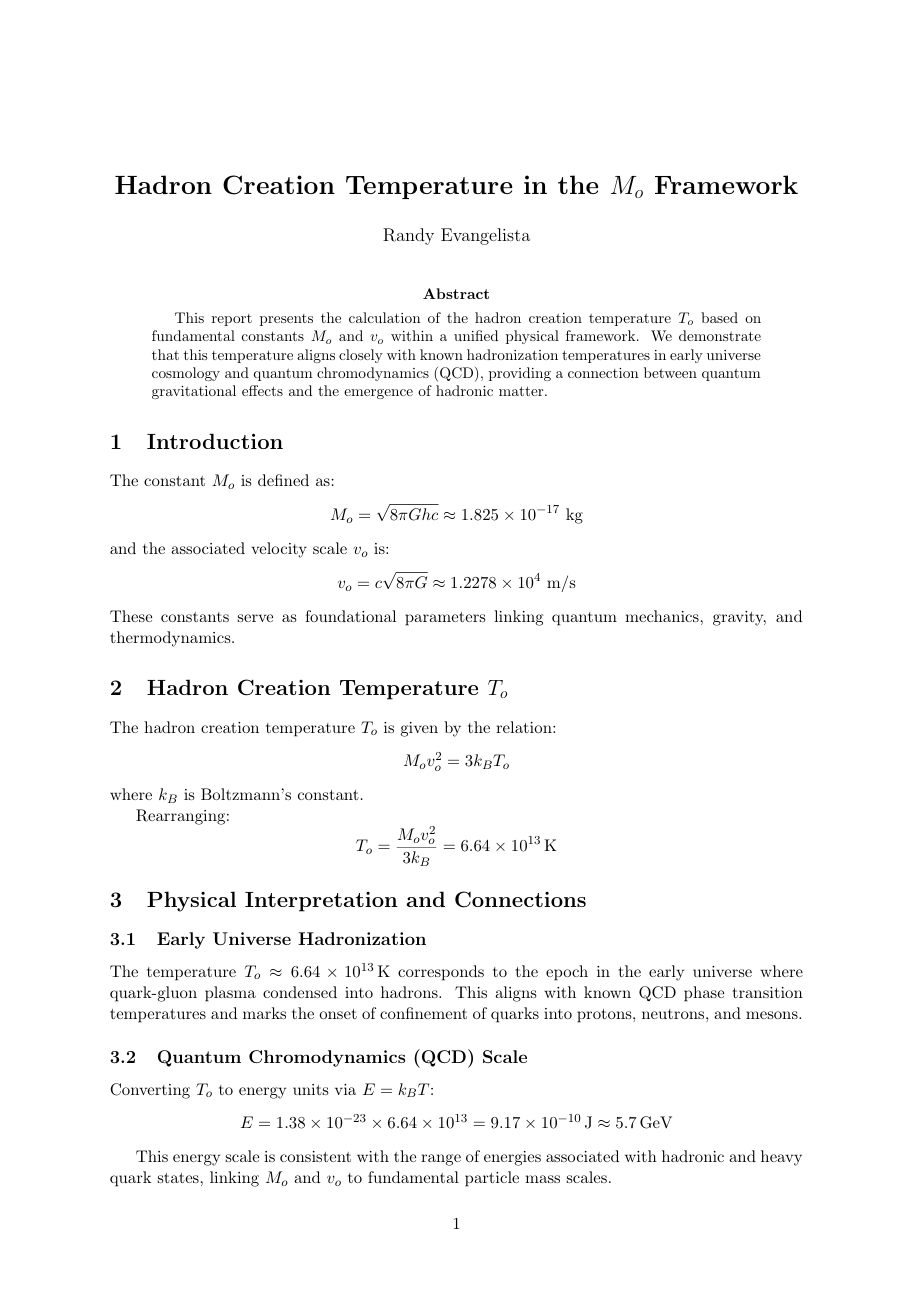
Hadron creation temperature
CMB temperature
Ground state energy of hydrogen
Elementary charge
Bohr radius
speed of light
Permittivity of free space
Permeability of free space
Bekenstein-Hawking black hole entropy
velocity (Maxwell-Boltzmann distribution)
The "Mo" concept and below equations are self-derived, (+30 years in the making and counting). It is the foundation for deriving many fundamental constants of nature from the very large to the very small.

On the Origin of Mo 👽
One key aspect of quantum mechanics is the superposition of states where a particle can exist in multiple states simultaneously.
Einstein’s GR is a new way of explaining gravity. However, it was not developed using quantum mechanics. This is the reason why university professors, researchers, physicists, cosmologists, mathematicians are on the hunt for a quantum version of GR.
This is the Holy Grail of physics and the one who will discover a solution will have a free plane ticket to Stockholm, Sweden and receive the Nobel Prize in Physics.
Instead of quantizing GR or gravitizing quantum mechanics, another approach is to define a theoretical minimum mass, “Mo” (1.825E-17) wherein the superposition of states will disappear. "Mo" is still very small compared to the Planck mass. This approach will not contradict the two cornerstones of physics, (GR and Quantum Mechanics).
The idea behind “Mo” is that if an object is large enough, the superposition of states will disappear and the object will exist in just one observable state. When the total mass reaches 11000 MDa (1.825E-17 kg), the wave function will collapse.
At the same time, the gravitational property of the object will emerge from the combined mass. Same analogy for water that it is not possible to describe its properties by studying one molecule of H2O.
Mo and the Quantum Form of Kepler's Third Law








Comments